Kefei Yan

Kefei Yan

Georgia Tech MSCS, building AI for the physical world.

Graduate researcher, HAAG @ Georgia Tech · graduating December 2026

Agent mode →


Currently pursuing an MSCS at Georgia Tech (AI track), graduating December 2026, and doing biodiversity-monitoring research with the HAAG group there. Previously completed an online MS in Data Science at CU Boulder (GPA 3.99) while working as an AI Engineer, and a BSc at the University of Toronto. Six years of prior industry experience across Canada and China, most recently as an AI Algorithm Engineer at Zhongke HZ Technology, building computer vision and machine-learning inference systems for environmental surveillance. Spent summer 2026 at Dematic as an AI Engineer Intern, prototyping enterprise agentic workflows and the criteria for evaluating them.

Research interests

Evaluating machine learning and multi-agent LLM systems that support consequential decisions in environmental and other high-stakes settings, where ground truth is contested and errors fall unevenly across the people affected; the measurement questions underneath that, such as how sampling design and detection limits shape what a monitoring record can support; and decision support that makes its own reasoning, and its own failures, legible to the people who have to act on it. FireFair touches all three, the HAAG camera-trap work is the measurement thread, and CultivAgents evaluates a multi-agent system with the people who use it.

For research correspondence: kyan66@gatech.edu


Publications

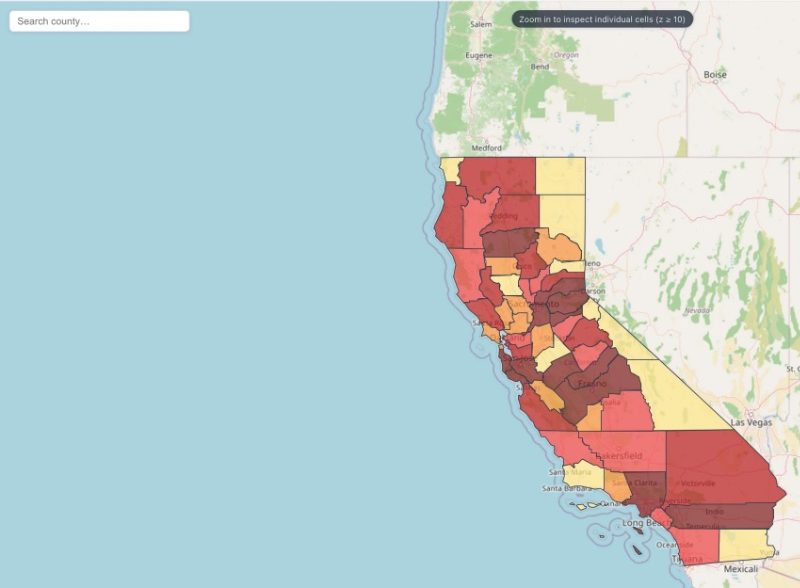
FireFair's statewide view: California counties shaded by adjusted ignition probability for 7 July 2026, above a toggle between the raw and adjusted scores and counts of total and alert-triggered cells.

FireFair: Equity-Adjusted Multi-Agent Triage for Wildfire Ignition Forecasting

Kefei Yan*, Frank F. Yang*, Yiyang Wang, Ziyi Yang, Kewen Liu, Yuzhuo Chen, Alex Cabral, Josiah Hester (* equal contribution)

ACM GoodIT '26, Pisa, Italy, September 2026 · work-in-progress paper, presented September 2026

Cut the equity recall gap by 75% for 1.6 F1 points; LLM agents verify the recovered cells against satellite evidence.

more about FireFair

Co-first-author paper, equal contribution with Frank F. Yang, advised by Alex Cabral (MIT) and Josiah Hester (Georgia Tech), who are among its six co-authors. It audits a California wildfire ignition forecaster by the CDC Social Vulnerability Index: at the standard threshold the backbone caught 69% of ignitions in the most vulnerable quintile versus 91% in the least. One auditable score-level adjustment cuts the held-out equal-opportunity gap by 75% (ΔEO from −0.155 to −0.038) for 1.6 points of F1 and routes the recovered cells to two gpt-4o agents, an Equity Agent for the SVI audit and a VLM Agent for Sentinel-2 and VIIRS evidence, whose tool calls stream live to the dispatcher. Work in progress: California only, validated forward-in-time on two 2025 fires. The link on this site is the project page, https://fire-fair.github.io/; there is no public code repository.
PyTorch (5-member InceptionTime + CutMix ensemble), FastAPI + PostGIS, gpt-4o function-calling agents over SSE, Sentinel-2 / VIIRS, React + Leaflet

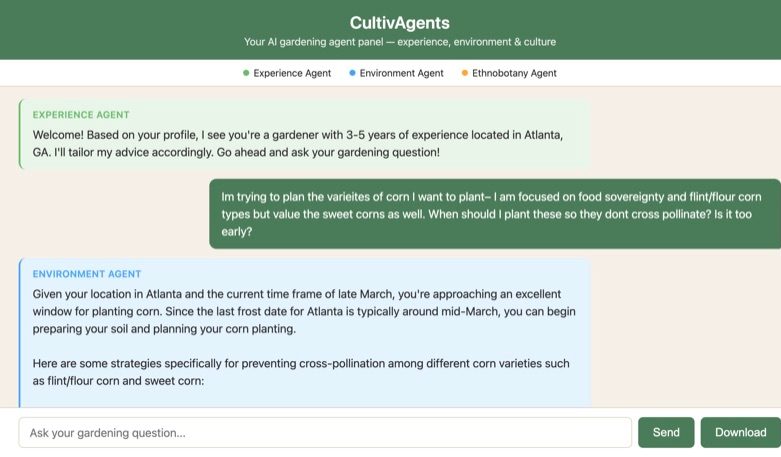
CultivAgents chat: a gardener asks when to plant corn varieties; the Experience Agent and Environment Agent reply in green and blue bubbles, with the Ethnobotany Agent listed in the header.

CultivAgents: Cultivating Relationship-Centered Multi-Agent Systems for Personalized Gardening

Yiyang Wang, Moeiini Reilly, Britney Johnson, Kefei Yan, Alex Cabral, Josiah Hester

arXiv preprint, May 2026

Three-agent gardening assistant; SUS 84.5 and trust to act from 3.2 to 4.0 in a 15-person, three-phase study.

more about CultivAgents

Three coordinated LLM agents in one chat: an Experience Agent that adapts guidance to the gardener's skill level, an Environmental Agent that grounds advice in hyperlocal soil, frost dates and season, and an Ethnobotanical Agent that connects plants to cultural knowledge. An LLM selector chooses who speaks each turn. Three-phase mixed-methods study with domain experts (n=3), HCI researchers (n=7) and community gardeners (n=5): confidence 3.00 to 3.60, trust to act 3.20 to 4.00, SUS 84.5/100. Fourth author of six, with Yiyang Wang, Moeiini Reilly, Britney Johnson, Alex Cabral (MIT) and Josiah Hester (Georgia Tech), advised by Cabral and Hester. My part: co-designing the agent roles, and the quantitative analysis for the three-phase mixed-methods evaluation, run under an IRB-approved protocol with gardeners at the Georgia Tech community garden, plus the workshop materials the sessions ran from.

AutoGen SelectorGroupChat, FastAPI + WebSocket streaming, Docker, single-page web app

Projects

Selected work

Digital Green Crop Yield Prediction· Gold-level recognition on Zindi · Rank 20/647

Stacked ensemble (CatBoost, LightGBM, ExtraTrees) for district-level crop yield prediction in India. Feature engineering across geographic splits.

Python, CatBoost, LightGBM, scikit-learn · Completed December 2023

competition page

Industrial Computer Vision Pipeline @ Zhongke HZ Technology· YOLO / DETR for real-time environmental surveillance

As AI Algorithm Engineer at Zhongke HZ Technology, developed an end-to-end environmental surveillance pipeline that joins a Java backend with Python machine-learning inference for real-time scene analysis, and a runway foreign-object-debris detection module. Evaluated YOLO, DETR and reinforcement-learning components for object detection and automated decision support, then tuned inference latency, frame rate and accuracy.

PyTorch, YOLO, DETR, Java backend, Docker · March 2022 to April 2024

Amazon Reviews NLP Pipeline· Distributed sentiment classification at scale

Distributed NLP pipeline on Azure Databricks processing millions of reviews. Supervised classification (Logistic Regression, XGBoost, LightGBM) reaching AUC 0.8951.

PySpark, Spark NLP, Azure Databricks · Completed March 2023

Ongoing research

Spatial Camera Trap (HAAG, Georgia Tech)· Where camera traps and IUCN range maps agree, and how much sampling that takes

Grouping cameras into arrays more than doubles community agreement, from 0.25 to 0.58; restricting to species over 500 g closes 96% of the national richness gap.

more about Spatial Camera Trap (HAAG, Georgia Tech)

Continental-scale analysis with the HAAG group comparing the mammal communities Snapshot USA camera traps actually record with the communities IUCN range maps predict: where the two agree, where they differ, and how much sampling a reliable estimate needs. Advised by Jenny McGuire and Steve Mussmann, with poster co-authors Neelima Pandey, John Hiedo and Marissa Douglas. Built a reproducible pipeline that merges 987,979 Snapshot USA wildlife records with IUCN range maps and COMBINE species-trait data into 713,319 analysis-ready records (surveys from 2019 to 2023, August to November each year) across 109 mammal species, 7,340 cameras and 262 arrays. Findings so far: pooling individual cameras into arrays more than doubled mean agreement between observed and expected communities, from 0.254 to 0.575, so the agreement a network reports depends heavily on the spatial scale at which it is read; limiting the analysis to species of at least 500 grams closed about 96% of the national richness gap, so most of the remaining error is detection sensitivity; five years of continuous survey raised mean similarity from 0.518 to 0.660 across 41 repeatedly surveyed arrays. A Random Forest trained on habitat, land-cover, development and road-distance covariates to predict agreement at each camera found that local site conditions, led by distance to the nearest road, then cropland and forest cover, matter most at the scale of individual cameras. Camera footprints and array unions are built in EPSG:5070 and compared with spatial joins, Jaccard similarity, species-accumulation curves and Chao–Jost coverage. Next: which species traits drive the disagreements between camera traps and range maps. Presented as the poster "Bridging Empirical and Modeled Biodiversity: Tracking Agreement between Camera Traps and Species Range Maps" at the Georgia Tech OMSCS Conference in May 2026.

Python, GeoPandas, Shapely, QGIS, rpy2 + vegan, Random Forest, spatial joins, species-accumulation curves, Chao–Jost coverage · In progress since May 2025

code repository

Experience

Jun–Aug 2026
AI Engineer Intern, Dematic (Atlanta, GA)
2025–present
Graduate Researcher, HAAG, Georgia Tech (Atlanta, GA)
2025–present
Graduate Teaching Assistant (Game AI, Enterprise Cybersecurity), Georgia Tech (Atlanta, GA)
2022–2024
AI Algorithm Engineer, Zhongke HZ Technology (Guangdong, China)
2020–2022
Technical Project Manager, Zhongke HZ Technology (Guangdong, China)
2018–2020
Project Coordinator, Mise Technologies (Toronto, Canada)

Education

2024–2026
MSCS, Georgia Tech · AI track, GPA 3.88
2022–2024
MS Data Science, CU Boulder · online program, GPA 3.99
2011–2015
BSc Biological Chemistry, University of Toronto